By Corey McWhinnie
Autumn 2013
The old man sinks into his chair in front of the fire. His children sit nearby. They are all quiet, watching the flames lick at the dry wood. The story they are about to hear is not new to them, in fact they have heard it many times before. The man swirls the scotch around and around in his hand, watching as the viscous amber liquid sticks to the side of the heavy glass. The warm aroma pleases him, oak barrels, fruit peel, and a touch of spice. Then he begins. “This is a tale about six blind men and an elephant…” the children’s eyes roll, yet they remain still and listen.
The sky is a clear, cool blue. Sunlight splinters through the last of the early morning mist. People are crawling out of sleeping bags, slowly emerging from their dew drenched dome tents. Wiping sleep from eyes, blinking like moles peering out of an earthy burrow. Kids are running about with youthful energy. “Too much for this time of morning” their parents lament.
Elsewhere, one of the festival tents is steadily filling. People are jostling for a better position in the lengthy queue outside. It’s the first act of the first day of the National Folk Festival in Canberra. Senor Cabrales watch from backstage. With eye brows furrowed, silvery beards quiver with anticipation and quiet bewilderment as more people squeeze in. Other performers have sent their condolences for drawing the worst set of the festival. Within minutes the tent is packed to capacity. Bodies are pushed tightly together. “I can’t breathe,” gasps one. Another shudders as all seven men move in toward them. Then music fills the air.
There is a story in everything I am told and so there is. Senor Cabrales for a start means Mr. Cheese in Spanish. Cabrales is a pungent smelling old hard cheese from a region in Spain called Asturias. Senor Cabrales on the other hand are a pungent smelling old band that plays music from Asturias. Similar you may say but very different. To realise the music of Senor Cabrales, understanding how the feelings of interconnectedness contrast with vast difference is important. This paradox coupled with cultural history weaves deeply through the music and the minds of the musicians.
History is about what went before but also about what comes after. Nick Rigby one of the founding members explains that “If we go back to the days where the Old World meets New World we may understand the collision of cultures in Northern Spain.” This might help explain why some of the traditional music Senor Cabrales plays uses complex rhythms, melodies and time sequences that draw on Moorish, Gaelic and Spanish influence which provide a rich texture that underscores and accentuates the songs. History is like that. Traditional music is sonic history. It has one foot in the past and the other is taking a step forward into the unknown.
With one step forward Senor Cabrales have released their first studio album titled Aqui. On the recording the band captures the sound and feel of their lively performances. They perform twelve traditional songs that originate from various regions including Asturias, Brittany, Galicia, Ireland and Scotland. The album is self-funded by the band members and recorded in a small studio in the Blue Mountains. The sound engineer said he had to wait for the coal trains rumbling in the background to subside before recording. The band has some upcoming gigs including the National Folk Festival where they intend to launch the album.
For the three day festival the band play to packed crowds every night. The release of the CD is an overwhelming success. “We don’t normally sell many CDs at festivals, but this time there was a line up after each gig to get a signed copy” said McWhinnie. Not only were Senor Cabrales one of the “must see acts” at the festival and had a bounty of CD sales, but word has it that they have now been nominated for an ARIA award. “To receive this recognition has been wonderful but it was definitely not expected” said McWhinnie. “Each of us works full time, but has been playing music for at least 30 years. Music is something we enjoy in our spare time.”
Six blind men and an elephant is a tale about how six men describe the beast based on their experience. The thing is that they all describe a part of the elephant, which as a collective end up describing the elephant in full. No one is wrong as their experience determines their outcome, but each perspective is vastly different. In the end having so many ways to perceive the same thing can be instrumental in learning new ways of thinking and seeing the world in full not just in parts.
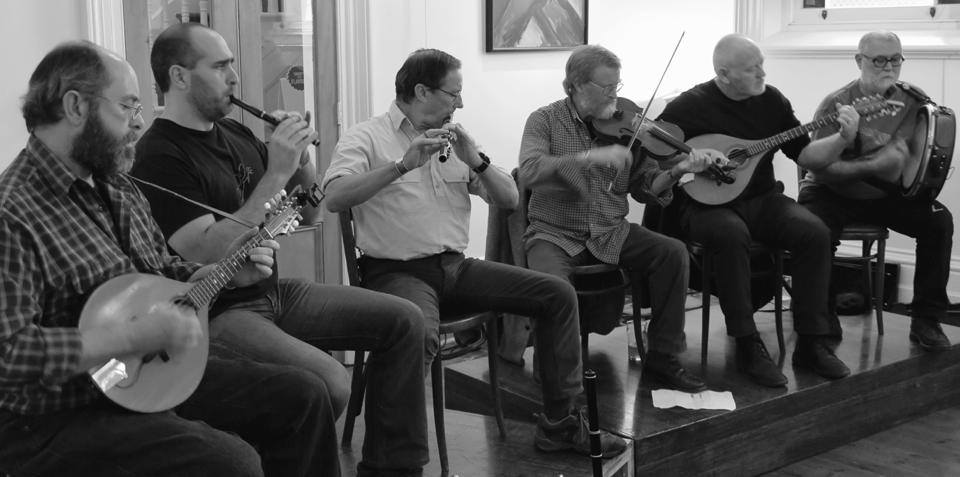
Introducing the band….Ian Stewart on flute and whistles (consultant), Juan Cordero (aero nautical electrical engineer) playing gaita and whistles, Roger Hargraves (retired orthopaedic surgeon) fiddle player also on charango and bazouki, Mark Roebuck (General Practitioner) on the mandolin and mandola, Nick Rigby (manager in local government) on bazouki and gaita Bruce Cameron (retired manager in state government) and Jim McWhinnie (disability seating consultant and technician) getting his “Bo Diddley Beat” down on bodhran.
The band was originally a five piece who recorded their first live album at Warpstanza Café in Bathurst, on an overcast Sunday afternoon in 2004. They played mainly tunes from Breton and a couple of Irish and Scottish jigs and reels. Their friendship with an Asturian band called Felpeyu influenced their playing style and their move toward playing Asturian music. Stewart joined in later years.
For the newest member of the band, Juan Cordero who was born in Asturias says “Joining Senor Cabrales is an unbelievable dream come true.” He thought he would never be able to play in a band, and said “the fact that I’m playing this music from Asturias and Galicia in Australia makes it even more unbelievable and unexpected, and makes me feel very proud of my origins.” So how did Juan come to join the band? Arriving in Australia in November 2011 he wanted to meet people he could play music with. Corderos said “I heard about a band of Australians that played music from Spain, called Senor Cabrales…”. It turns out that the next weekend Senor Cabrales was playing in Gulgong very near where Juan now lives. “So I went there, and listened to them for the first time. I remember that at the end of their gig, I had one of those moments that probably changed my life.”
Juan is shy and found it challenging to talk to a bunch of strangers but says “I was so touched by their music, so familiar to me, in such a tiny little town in the middle of nowhere in Australia, at the other side of the world from Spain, that I found enough courage in me to go see them after the gig to tell them how much I had enjoyed their music.” He started playing with them more regularly and finally, as a new member of the band played his first festival at Glen Innes in 2012. Juan says “I reckon that deciding to go and say hi to them after their gig in Gulgong has definitely been one of the best decisions I’ve ever made in my life.”
Getting Senor Cabrales together is like “herding cats.” Each has a vastly different lifestyle, different occupation, different background, different attitude to music. Ask any member of Senor Cabrales what type of music they play will certainly raise vastly different responses. But when they get together to play music, they create a sound that is unique, exciting and historic.
The only child left awake turns to the old man and says, “Who is the elephant?”
Senore Cabrales are playing at the National Folk Festival this weekend, see their Facebook page for more details- https://www.facebook.com/pages/Senor-Cabrales/157880774299217?fref=ts (image also sourced from this page)